
How Cameras For Girls Is Creating Career Pathways for Young Women in Africa
When people first hear about Cameras For Girls, they often assume we only teach photography.
We do. But photography has never been the destination.
From the very beginning, Cameras For Girls was created to address a recurring challenge we saw. Young African women were graduating from universities with degrees, ambition, and determination, yet many found it difficult to secure paid work. They had the theoretical knowledge but often lacked access to professional camera equipment, practical experience, mentorship, industry networks, and the portfolio needed to compete for opportunities.
That is the gap we set out to bridge.
Our year-long program combines practical photography training, ethical storytelling, business skills, mentorship, and access to professional equipment. Every part of the program is designed with one goal in mind: helping young women move into meaningful, paid careers in photography, journalism, communications, and visual storytelling.
Sometimes the impact of that work is seen through employment.
Sometimes it is seen through leadership.
And sometimes it is seen when one of our graduates shares a story that reaches an international audience.
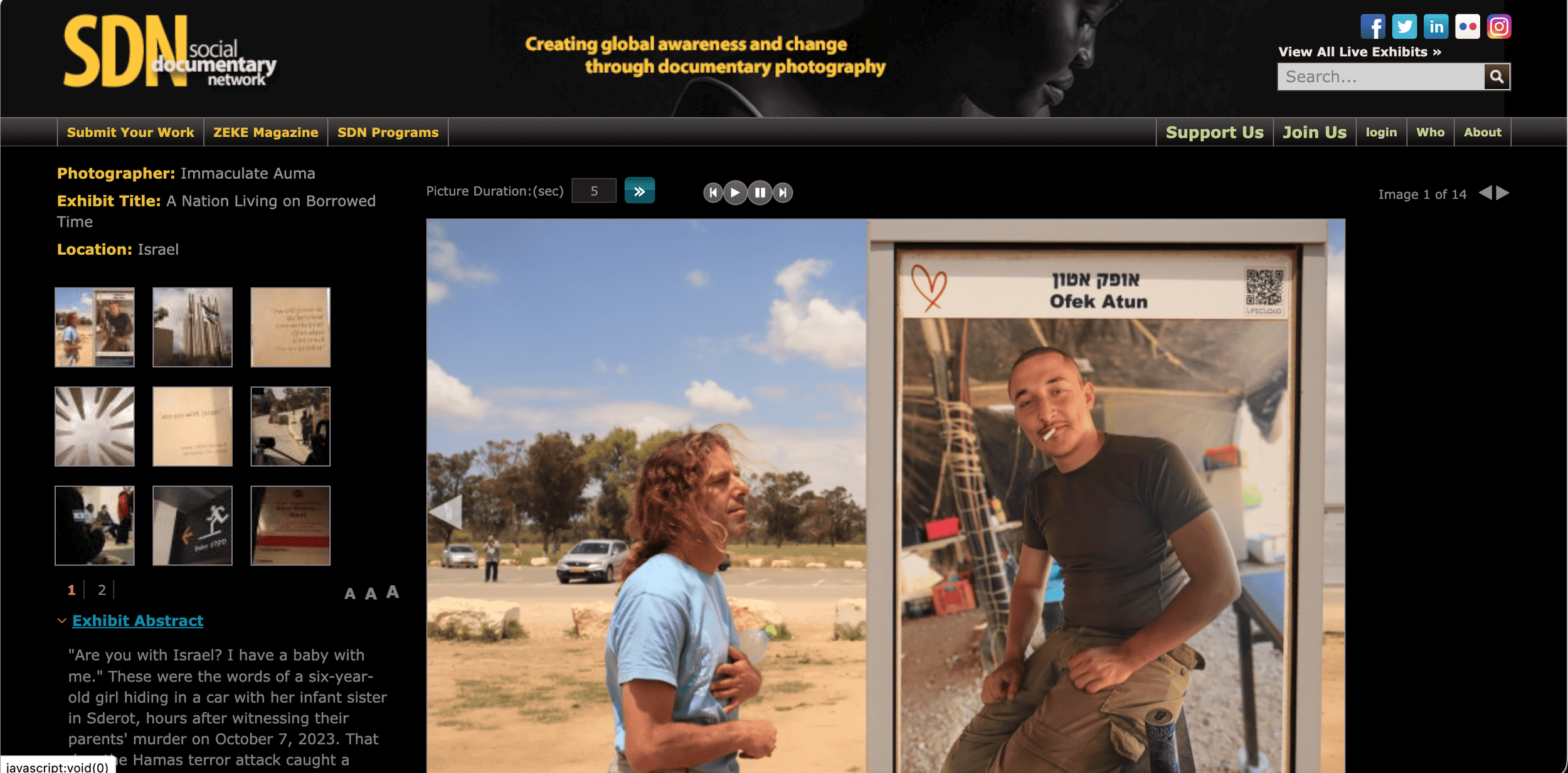
Screenshot of Immaculate Auma’s feature on SDN
Building on a Strong Foundation
When Immaculate Auma joined Cameras For Girls, she had already graduated from Uganda Christian University with a strong foundation in communications and storytelling.
She did not need another degree.
She needed the opportunity to strengthen her portfolio, gain practical experience, receive mentorship, and learn how to tell visual stories that reflected both her values and her lived experience.
Throughout our year-long program, students complete assignments that challenge them to think beyond taking technically strong photographs. They learn to ask deeper questions about dignity, informed consent, context, representation, and the responsibility that comes with documenting another person’s story.
These are not simply photography skills.
They are professional skills that prepare our graduates to work thoughtfully across journalism, nonprofit communications, advocacy, and documentary storytelling.
Learning Across Borders
Last year, Immaculate travelled to Israel to pursue her Master’s degree in African Sustainable Communities at Ben-Gurion University.
Although she was now studying thousands of kilometres away from Uganda, she remained committed to completing Cameras For Girls’ year-long program. She continued submitting assignments alongside her fellow students, using the environment around her to develop her documentary practice.
One assignment became something much bigger, throwing her into the proverbial deep end without a life raft. She was living in a country that was being bombed daily. Coming from Uganda, a landlocked country in East Africa, she was not used to seeing this level of death and destruction unfold in front of her eyes.
A Story That Deserved to Be Seen
While living in Israel, Immaculate documented life following the events of October 7, 2023.
Her documentary photography project, A Nation Living on Borrowed Time, explores grief, collective trauma, and resilience through photographs and personal testimonies. Rather than focusing only on a historical event, her work examines how people continue to navigate daily life in the aftermath of profound loss.
When I reviewed her final assignment, I immediately thought of the Social Documentary Network. I immediately saw the immense talent that she was developing, but she could not yet see it in herself.
For several years, Cameras For Girls has had the privilege of knowing Glenn Ruga and following the important work he has built through the Social Documentary Network. It is a respected international platform that showcases documentary photography exploring social issues from around the world.
I encouraged Immaculate to submit her work.
She did.
Today, her project has been published by the Social Documentary Network.
For an emerging photographer and communicator, this kind of recognition represents far more than a publication credit.
It is validation that her work stands alongside that of documentary photographers from around the world and that her voice deserves a place in global conversations.
Beyond Recognition
Publication is exciting, but it is not the outcome we measure most.
What matters is what recognition creates.
It strengthens a professional portfolio.
It builds confidence.
It expands professional networks.
It creates opportunities that may not have existed before.
For many young women entering competitive industries, those moments can become career-defining.
This is why Cameras For Girls exists.
Not simply to teach photography.
But to help talented young women move from education into employment.
Measuring Success Through Opportunity
Success is not measured by how many students complete our program.
It is measured by what happens after they graduate.
Are they finding paid work?
Are they building professional portfolios?
Are they securing freelance assignments?
Are they working in communications, journalism, or media?
Are they returning to mentor future students?
Are they being recognized for the quality of their work?
Immaculate’s story is one example, but it reflects something much bigger.
Across Uganda and Tanzania, our graduates are photographing events, documenting community initiatives, supporting nonprofit communications, building freelance businesses, contributing to newsrooms, and telling stories that might otherwise go unheard.
Each success strengthens the pathway for the young women who will follow.
The Next Step Requires Partnership
Training is only one part of the journey.
For our graduates to build sustainable careers, they also need organizations willing to invest in their talent through paid opportunities.
That is why we are always looking to build relationships with nonprofits, businesses, foundations, media organizations, communications agencies, universities, and development partners that can hire our students and graduates.
Our graduates are available for documentary photography, event photography, NGO field storytelling, campaign photography, community interviews, communications support, and visual storytelling projects.
When you hire a Cameras For Girls graduate, you are not making a donation.
You are commissioning professional work while helping a talented young woman strengthen her portfolio, earn an income, expand her professional network, and continue building a sustainable career.
If your organization believes in investing in local talent and ethical storytelling, we would love to hear from you.
Learn more about working with our students and graduates:
https://www.camerasforgirls.org/work-with-us
Looking Ahead
Today, Immaculate describes herself as a strategic communicator and media professional working at the intersection of storytelling, climate, policy, and global development.
As she completes her Master’s degree, she is seeking her next opportunity to continue using storytelling to communicate complex issues with clarity, empathy, and integrity.
We hope this publication opens new doors for her.
Because that is what Cameras For Girls is ultimately about.
Creating opportunities and building careers.
Ensuring that talented young women are recognized not only for their potential, but for the quality of the work they produce.
Congratulations, Immaculate.
We are incredibly proud of everything you have achieved, grateful to Glenn Ruga and the Social Documentary Network for providing a platform that celebrates thoughtful documentary photography, and excited to see where your journey leads next.
Read Immaculate Auma’s documentary project, A Nation Living on Borrowed Time, published by the Social Documentary Network: