

Year-Long Photography and Ethical Storytelling Training for African Women
Our Year-Long Program
Cameras For Girls is a registered Canadian charity and Ugandan nonprofit working to advance gender equality in Africa’s media sector. We provide each participant with a camera and guide them through a four-phase, year-long program in photography, ethical storytelling, and business skills. By blending hands-on training with mentorship and career support, we help young women move from education into paid work in journalism and photography - fields where they’ve historically been excluded.
We know our program works: An impressive 80% of our graduates have secured full-time paid positions in journalism, communications, and photography-related careers.
The 4-Phases of Our Flagship Program
Each phase of our program builds toward one goal: helping young women secure paid work in media. From the first time they pick up a camera to the moment they publish a portfolio, receive mentorship, and connect with employers, our students are guided every step of the way. This pathway ensures they don’t just gain skills—they gain the confidence, tools, and opportunities to turn those skills into sustainable careers in journalism, photography, and communications.
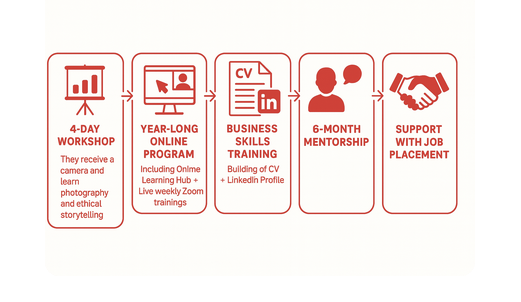
Phase 1
Over four days, students build a strong foundation in both technical skills and ethical storytelling. For the first three days, they learn in the classroom—covering camera basics, moving from automatic to full manual operation, and practicing core photography techniques. On the fourth day, they head into the field with a local NGO partner, where they receive hands-on training in documenting real stories using ethical, respectful approaches. Each student is provided with her own camera to keep, setting her up for the journey ahead.
Phase 2
After the in-person workshop, training continues online with a focus on advanced photography concepts and deeper application of ethical storytelling.
Students receive:
24/7 access to the Online Learning Hub covering photography, storytelling, and business skills.
Weekly Zoom meetings for discussion, advanced training and personalized feedback.
Bi-weekly photo reviews and monthly assignments to strengthen their skills.
Digital marketing training to build professional visibility.
Editing instruction in Photoshop and Lightroom.
Mental health support, through partnerships.
This phase ensures students keep growing beyond the classroom, sharpening their skills while building consistency, confidence, and a professional workflow.
Phase 3
Phase 3 focuses on building the skills needed to move from training into stable, paid work—directly aligning with UN SDG Goal #1: End Poverty.
Students learn how to:
Write professional resumes and craft compelling LinkedIn profiles
Develop a business plan and create a financial cushion for self-employment
Network effectively, from promoting themselves on social media to researching opportunities
Build a strong professional online presence to stand out to employers
This phase prepares students not only to seek jobs but also to create sustainable livelihoods as photographers, journalists, or entrepreneurs.
Phase 4
In the final phase, students join an intensive six-month mentorship program, receiving one-on-one guidance tailored to their goals. Mentors provide feedback, encouragement, and practical advice to help each student navigate challenges and step into the professional world with confidence.
This mentorship bridges the gap between training and employment—helping students build networks, refine their craft, and secure real opportunities. It’s where dreams begin to take shape as careers.
What Does Each Workshop Cost?
Each 4-phase program workshop costs approximately $20,000 CAD.
The breakdown of the costs is as follows:
Cameras + Accessories for 15 Students: Each student gets a Canon camera (either Canon G1x or Canon R100), camera case, battery, charger, converter plug, and SD Card reader, which costs approximately $7,500 - $8,000 CAD (we offset this cost with in-kind donations). Learn how to donate your used or new cameras HERE.
Training Facility for the 3-Day Workshop: $1,800 CAD
4th Day Practical Session (Travel, Food, Logistics): $750 - $1,000 CAD (depends on how far we must travel)
Breakfast and Lunch for the 3-Day Workshop: $2,000 CAD
Travel Costs for Amina to Train: $5,000 CAD (we do our best to conduct two workshops on the same trip, therefore saving money).
Trainers and coordinator fees: $1,500 - $2,000 depending on our needs.
Your support ensures we can continue providing these essential resources and opportunities to empower young women through photography.