
Why Mental Health Is Foundational to Our Work
When Cameras For Girls first began, our focus was practical and clear. We were closing the gap between theory and hands-on experience for young women graduating from journalism and communications programs. We provided cameras, delivered technical training, strengthened business skills, and built pathways into paid work.
But as our graduates began entering newsrooms and production spaces in Uganda and Tanzania, the stories we started hearing shifted.
They were no longer about exposure settings or editing software.
They were about safety.
Young women told us they were being harassed at work. Some were pressured to exchange sex for pay. Others were told their contracts depended on being “cooperative.” Some were sent on assignments where male supervisors expected to share hotel rooms “to reduce costs.” The power imbalance was clear.
These were not isolated incidents. They were patterns.
And we understood that preparing women for male-dominated industries without preparing them for these realities was incomplete.
So we changed the curriculum.
Recently, during our 4-day workshop in Tanzania, we were excited to partner with TAHMEF. They are a nonprofit advancing mental health awareness and psychosocial support through community-based education and advocacy.
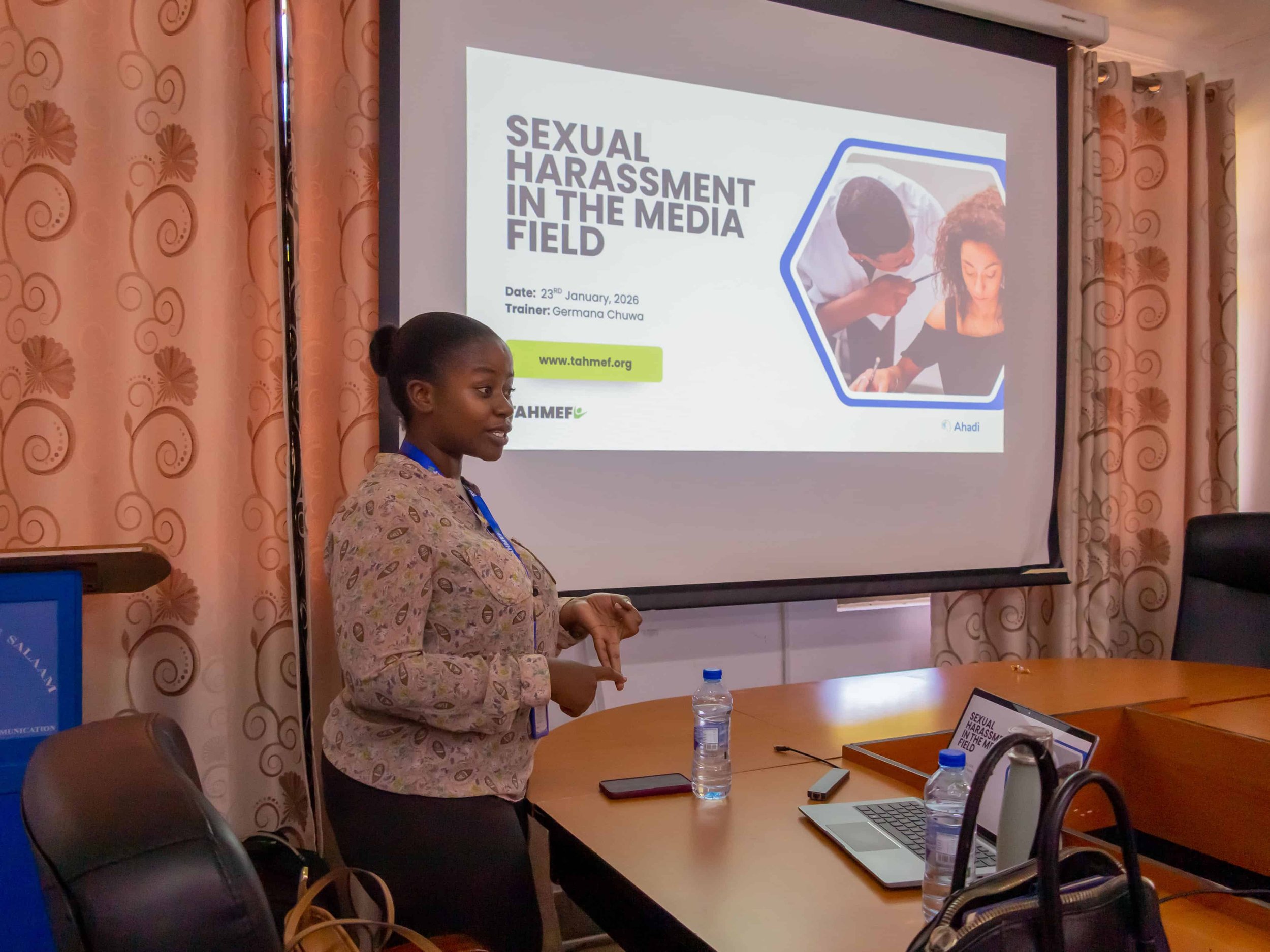
Germana Chuwa, Psychotherapist and Mental Health Advocate. Photo taken by Elfrida Rutta (former student from Cohort 2, Tanzania)
Why We Integrated Mental Health and Advocacy
We formally integrated mental health and sexual harassment advocacy into all of our programs.
Not as a reaction to one incident, but as a structural shift.
We began teaching our students how to recognize coercion, establish professional boundaries, document incidents, report harassment, and access psychosocial and legal support. We also created space to address stress, trauma responses, and the emotional toll of navigating unsafe environments. This is done through our 4-day workshop and during our year-long program.
Technical skill without safety leaves women vulnerable.
If we are serious about sustainable careers, we must prepare women for the whole environment, not just the job description. Sadly, we cannot control how people with power act, but we can prepare our students to be proactive rather than reactive.
Finding the Right Partner in Tanzania
As our work expanded in Tanzania, we knew this component needed to be locally grounded.
We are not mental health professionals. And we are not Tanzanian. If we were going to address mental health responsibly, it had to be led by those rooted in that context and the culture. We do the same in Uganda, addressing mental health and sexual harassment are not easy subjects to speak about, when they are steeped in shame and stigma.
After following Dr. Juliana Busasi's posts on LinkedIn, we learned more about TAHMEF (Tanzania Health and Medical Education Foundation) and reached out. What followed were several months of conversation about what our young women were experiencing and how TAHMEF was approaching mental health within Tanzania.
Their work centers on reducing stigma, increasing access to mental health information, and equipping young people, especially women, with practical tools to understand and advocate for their well-being.
There was clear alignment.
Together, we agreed that TAHMEF would deliver a 90-minute live session during our four-day workshop.
Why We Moved the Session to Day One
Originally, mental health sessions were placed later in the workshop.
This year, because of a scheduling challenge, we had to move it to day one - that was an unintentional shift, but it paid off in ways we could not foresee.
TAHMEF facilitated the session with cultural depth and practical guidance. The women opened up. They shared experiences. We listened. TAHMEF provided language, context, and strategies.
Advocacy cannot wait until after harm occurs. For many young women entering professional media spaces, the challenges begin immediately. Beginning with mental health signals something fundamental: your well-being is not secondary to your career. Your safety matters as much as your skill.
What Advocacy Looks Like in Practice
The impact of this training is not theoretical.
One of our Cohort 1 students in Tanzania, way back in 2023, was assaulted on her way home on a city bus. Instead of remaining silent, she went directly to the police station and filed charges. The case was followed up. The bus driver was fired. Both perpetrators were charged. She received a settlement.
That outcome does not erase what happened. But it reflects something important: she knew her rights, and she believed she could assert them.
That confidence is strengthened when women are taught early, clearly and without apology that their safety matters.
This Work Is Ongoing
The partnership does not end with a single workshop.
TAHMEF has agreed to deliver quarterly sessions, creating ongoing space for our Tanzanian cohorts to share challenges and strengthen their advocacy as they move into professional environments.
Learning to advocate for yourself is not a one-time lesson. It is a practice.
Mental health is not an add-on in our program.
It is foundational.
Before a woman can confidently tell the stories of her community, she must know she has the right and the support to protect her own.
Work With Us
Technical training opens doors.
Safety keeps women in the room.
Your support allows us to integrate mental health, advocacy, and local partnerships like TAHMEF into every cohort, not as an add-on, but as infrastructure.
If you want to help build safer pathways for young women entering media across East Africa, consider making a donation today.