
Earlier this year, Cameras For Girls was preparing to bring together 20 graduates from across all five of our Uganda cohorts for our first alumni workshop.
The workshop was originally scheduled for April, but the Ebola outbreak halted those plans. Once it was safe to regroup, we were finally able to bring the selected alumni back together for three days of advanced training from October 16–18, 2026.
This time, however, the focus was different. It was not simply about becoming better photographers. Our alumni already had the technical foundation and were continuing to practise their skills in the field. The question now was how to take those skills further and turn them into real career opportunities within Uganda’s media industry.
For us, that meant shifting the conversation from how to take the photograph to how to build a career around the skills behind it.
We wanted the workshop to help these women think more deeply about employment, freelance work, fair pay, contracts, client expectations, professionalism and the business side of working in media.
Because at Cameras For Girls, the goal has never been training for the sake of training. The goal is to help young women move from learning a skill to earning from it.
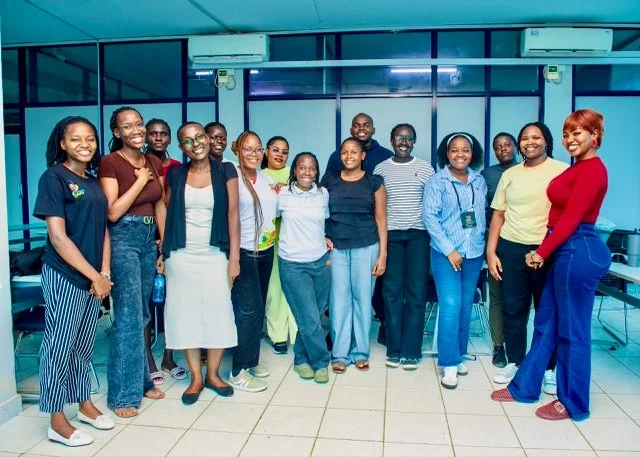
Our alumni and trainers, at the Alumni Workshop in Uganda, October 2026
Meeting Our Alumni Where They Are Now
Our alumni already know how to take photographs. They continue to practice their photography skills after graduating from Cameras For Girls, and many now use photography, communications, and ethical storytelling in their jobs, freelance assignments, and fieldwork.
Before inviting them back for advanced training, I wanted to see that continued growth through their portfolios. I did not want us to repeat the same lessons they had already received.
What became clear was that many of the women now needed support with a different question:
How do I turn the skills I already have into paid work?
At Cameras For Girls, that is ultimately what career pathways mean. Our goal is not simply to teach women how to use a camera. We want to help them move toward paid opportunities, whether that means full-time employment, freelance work or building businesses of their own.
Going Deeper Into Business Skills
Our Uganda trainers, Joyce Mollan, Sheilla Clara, Melanie Joyce Nabukwasi, and Miriam Najjingo, along with our coordinator Alex, led the workshop. I, of course, could not be there this year, as I am still recovering from back surgery. Putting my trust in a locally led training without my support was a good test of how we move fully to this model over time.
The training went deeper into many of the areas our alumni are now encountering as they move further into the workforce.
How do you negotiate fair pay?
What should you understand before agreeing to a contract?
How do you meet a client's or employer's expectations once you have been hired?
How do you position yourself professionally?
How do you begin thinking about your photography and communications skills as a business?
We already introduce business planning, LinkedIn and career-readiness skills through our core program, but our alumni were ready for more advanced conversations. We also reviewed technical photography skills for those who needed a refresher. The point was not to teach everyone the same thing again. It was to meet each participant where she was and help her move forward.
When the Field Assignment Did Not Go as Planned
On the third day, we followed a model that has always been an important part of Cameras For Girls training: partnering with a local NGO so participants can practice photography and ethical storytelling in a real-world environment.
This time, the organization worked with a school in one of Kampala’s largest informal settlements.
Unfortunately, once the group arrived, members of our team were targeted by pickpockets and no longer felt safe. They tried for about an hour to continue gathering photographs and stories for the NGO, but our trainers ultimately decided to end the assignment. It was disappointing, but it was the right decision.
No photograph, story or training exercise is worth putting our students or team at risk.
We will arrange another practical training day so the alumni still receive that important part of the experience.
Investing in Local Leadership
One of the things I was most proud of during this workshop was that our trainers led it, alongside Alex Paul Sekitoleko. Our trainers are, Joyce Mollan, Melanie Joyce Nabukwasi, Miriam Najjingo and Sheilla Clara Apio.
Back in 2024, we made a deliberate investment in our Train-the-Trainer program so that the knowledge, skills and values behind Cameras For Girls would not sit with one person. That investment continues to pay off.
Our trainers taught the sessions, supported the alumni and made the decisions that needed to be made when things did not go according to plan.
As Cameras For Girls continues to evolve, I want our trainers and local team to play an even greater role in shaping and delivering the program. Our programs and outreach across Africa are growing, and so is the leadership capacity of the people closest to the work.
From Photography Skills to Career Pathways
Perhaps the biggest change we are seeing is in the questions our alumni are asking.
They are moving beyond:
How do I take a better photograph?
and toward:
How do I build a career from these skills?
The camera may remove one barrier. Practical training removes another. But mentorship, business skills, professional networks, fair pay, and access to real opportunities help turn those skills into a career. Our end goal has never been training alone.
It is helping young women turn their skills into paid work and build careers they can keep growing.
A Special Thank You
This workshop was made possible in part through the generosity of Anita Patterson, a Canadian photographer who supported the training through her Donor-Advised Fund.
As a photographer herself, Anita understands the value of having both the technical skills and the opportunities to build a career. Her support helped us bring our alumni back together and invest in the next stage of their professional development.
We are incredibly grateful for her belief in these young women and in the work of Cameras For Girls.
We look forward to sharing the photographs, stories, and outcomes from the workshop with Anita in the coming weeks, so she can see what her investment helped make possible.