
The Pipeline Is Not the Problem. The Pathway Is.
Across Africa, young women are studying journalism, communications, photography, and digital media. They are in classrooms, completing coursework, learning theory, acquiring practical skills, and preparing for careers in industries that shape how communities are seen and understood.
They are not lacking ambition. They are not lacking ideas. They are not lacking talent.
They are lacking access.
Access to equipment. Access to practical training. Access to mentors. Access to networks. Access to paid assignments. Access to the kind of support that helps a young woman move from education into earning.
Hence, the pipeline is not the problem. The pathway to paid work is.
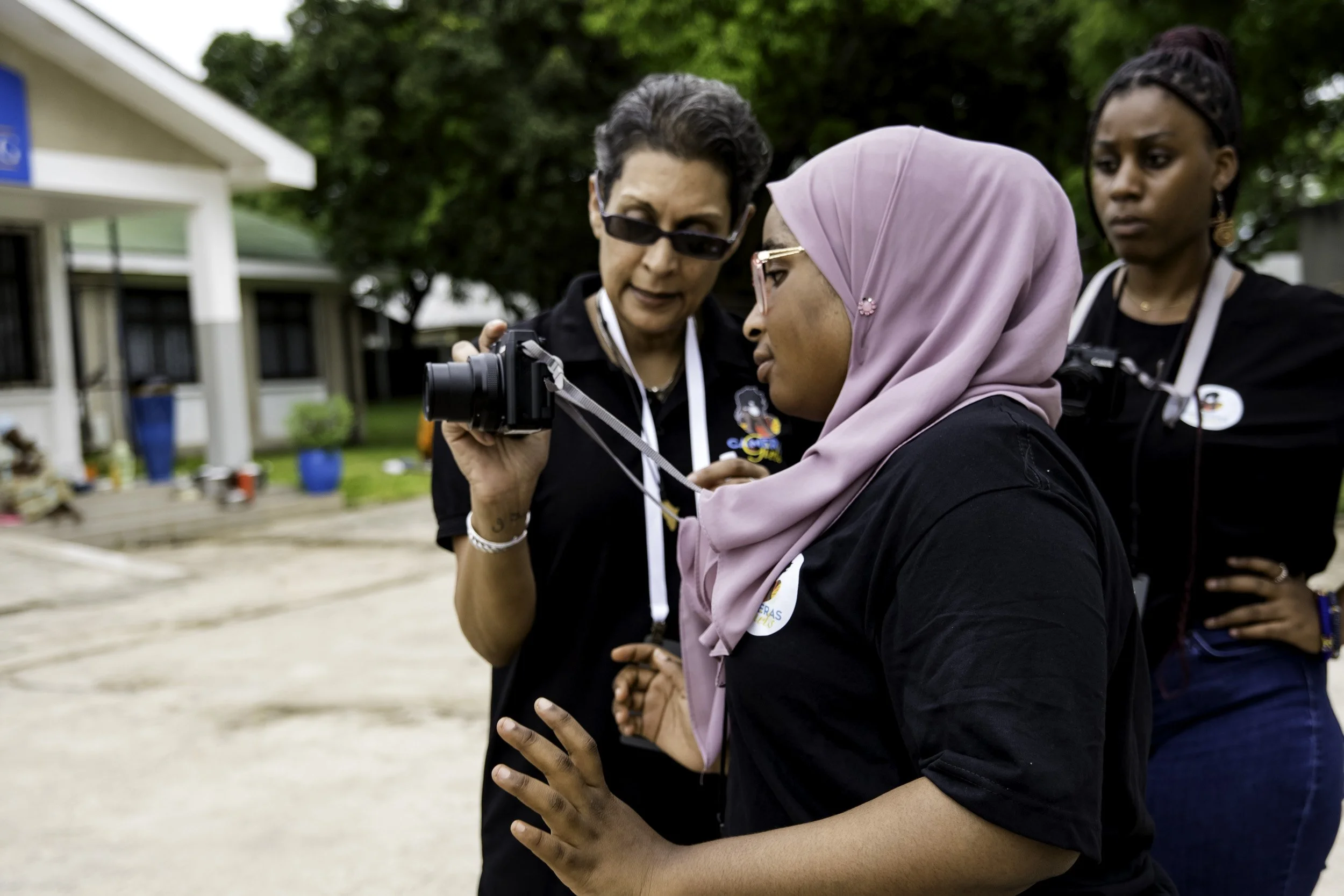
Amina showing Aisha the settings of her camera, during the workshop in Tanzania, November 2023
Education Does Not Always Lead to Opportunity
At Cameras For Girls, many of the young women who join our program have already studied or are currently studying journalism and communications. They come to us with knowledge, curiosity, and a deep desire to work in media.
But a journalism degree does not automatically come with a camera. A communications course does not guarantee field experience. A strong desire to tell stories does not mean a young woman has a portfolio, industry contacts, mentorship, or the confidence that comes from consistently using professional tools.
This is the gap we see again and again. This is the gap we intentionally designed our program to fill.
Young women are doing the work to prepare themselves, but the systems around them do not always provide the next step. In male-dominated media spaces, they are often expected to prove themselves without the same resources, access, or safety as others.
Why We Give Every Student a Camera to Keep
At Cameras For Girls, every student receives a camera to keep. We are often asked why we do not simply give them a smartphone instead.
The answer is simple: a camera changes what is possible after the training ends.
When a young woman owns her own camera, she can practice consistently. She can accept assignments, build a portfolio, and document stories in her own community. She does not have to wait to borrow equipment, pay rental fees, or depend on someone else before she can say yes to an opportunity.
In many media spaces, the lack of a camera becomes a gender-based barrier to entry. Too often, the lack of professional equipment becomes another reason young women are kept out of photography, journalism, and communications work. By giving each student a camera to keep, we remove that barrier from the start.
It gives her independence. It gives her consistency. It gives her access to work. It is the difference between learning a skill once and being able to keep building it long after the workshop ends.
Tools do not create talent, but without tools, talent is too often left unrealized.
Ethical Storytelling Is Part of the Pathway
We do not only teach the art and technical skill of photography. We go beyond that with our Ethical Storytelling Framework.
At Cameras For Girls, photography is tied to ethical storytelling because how a story is told matters. Images can build understanding, but they can also cause harm. They can challenge stereotypes or repeat them.
Across Africa, too many stories have been told through outside perspectives that focus only on poverty, crisis, or need. We believe young women from within their own communities must have the tools and training to tell stories with dignity, accuracy, and care.
Our students learn to think about consent, context, representation, and respect. They learn that the person in front of the camera is not simply a subject, but a human being with agency and voice.
This is central to our work because we are not only helping young women enter the media space. We are helping shift who gets to tell the story.
One Workshop Is Not Enough
A one-off workshop can introduce a skill, but it rarely creates a career pathway. That is why Cameras For Girls was built as a longer program. Through our year-long program, our students receive hands-on training, continue learning online through our Online Learning Hub, complete assignments, receive feedback, build portfolios, develop digital and business skills, and participate in mentorship.
This structure matters.
Confidence takes time. Skill takes practice. A portfolio takes consistency. Career readiness takes guidance. If we want young women to enter, earn, stay, and grow in media, we have to invest beyond the initial four-day workshop.
The Goal Is Paid Work
The goal is not simply for a student to learn how to use a camera. The goal is for her to use that skill to access paid work, build professional credibility, and create more choices for her future.
This is why we focus on outcomes. Can she use her camera confidently? Can she tell stories ethically? Can she build a strong portfolio? Can she apply for media jobs or take on freelance assignments? Can she earn from the skills she has developed?
That is the measure that matters.
Equity cannot be measured by how many women are invited into a room or attend a training. It must be measured by the changes that follow. The ripple effect becomes even more important because when a young girl, destined only for early marriage, sees a peer using a camera confidently to tell stories, her life can change, too.
This Is INpowerment
At Cameras For Girls, we do not believe young women are waiting for someone else to give them power. The power is already there.
What we do is help remove the barriers that keep that power from being seen, used, and valued. We provide tools, training, mentorship, and career support so young women can build confidence, tell their own stories, and pursue paid work in media.
That is INpowerment.
It is not speaking for young women. It is helping ensure they have what they need to speak, create, lead, and earn for themselves.
Why This Matters for African Media
Media shapes what people believe is important. It influences whose stories are seen, whose voices are trusted, and whose experiences are taken seriously.
When women are missing from photography, journalism, and communications spaces, the stories being told are incomplete. This is especially true when documenting the lives of women in rural communities. There are stories women will not tell freely to a man behind the camera. There are details, fears, responsibilities, and realities that require trust before they can be shared.
That trust matters.
When a woman is behind the camera, the story can be told with greater dignity, accuracy, and care. She is not extracting someone’s pain for an assignment. She is creating space for another woman to be heard on her own terms.
Across Africa, young women are ready to be the storytellers of their communities. They want to be photographers, journalists, communications professionals, and future media leaders who must be present if African media is going to tell the full story.
At Cameras For Girls, this is the work we are doing across Africa: helping young women move from education into earning, from learning into practice, and from being overlooked to being recognized as media professionals.
A Question for Our Community
What pathway helped you move from education into paid work, and who helped open that door for you?
And if you are in a position to support the next generation of women in African media, what pathway can you help build?