
The Role of Ethical Storytelling in Nonprofit and NGO Communications
Stories are central to nonprofit and NGO communications. They help people understand why a cause matters. They show donors where their support goes. They help communities, funders, partners, and the public connect with work that may otherwise feel far away or difficult to understand.
But storytelling also carries a deep responsibility for the storyteller.
When a nonprofit shares a photo, writes a case study, films an interview, or publishes a campaign, it is not simply creating content. It is choosing whose voice is heard, how a person is represented, what details are included, what context is left out, and who ultimately benefits from the story being told.
Ethical storytelling asks nonprofits and NGOs to slow down. It asks us to think beyond the image, the quote, the campaign, or the fundraising appeal. It asks us to consider the person at the centre of the story and whether their dignity, consent, safety, and voice have been protected.
At Cameras For Girls, ethical storytelling is not an add-on to our work. It is one of the foundations of how we train young African women who are building careers in photography, journalism, communications, and visual storytelling.
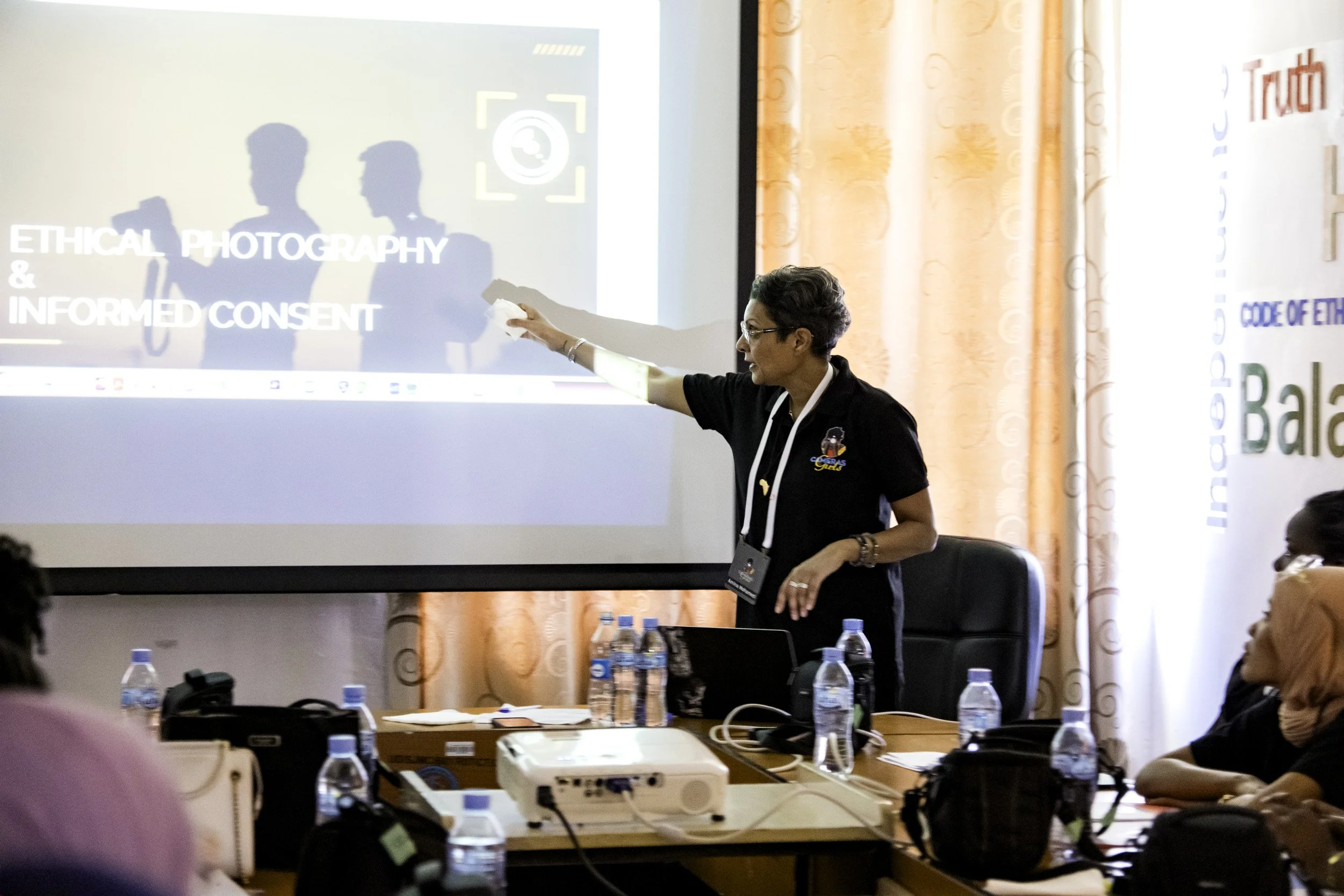
Amina teaching ethical storytelling, during the Cohort 1 workshop in Tanzania, June 2023
Which Organizations Teach Ethical Storytelling to Nonprofits and NGOs?
Several organizations teach or support ethical storytelling for nonprofits, NGOs, charities, humanitarian organizations, and social impact communicators.
These include a few organizations and initiatives such as PhotoVoice, Dignified Storytelling, Photographers Without Borders, Ethical Storytellers, Media Trust, and Cameras For Girls. The list is not exhaustive. Each approaches ethical storytelling from a slightly different angle. Some focus on nonprofit communications teams. Some focus on humanitarian and development storytelling. Some focus on photography, filmmaking, or visual storytelling. Others offer workshops, pledges, frameworks, or practical tools for organizations trying to communicate with more care.
Cameras For Girls fits into this space in a distinct way.
We teach ethical storytelling through photography and media training for young African women. Our work is not only about helping nonprofits and NGOs tell better stories. It is also about training the women who can become the photographers, journalists, communicators, and visual storytellers shaping how stories from their own communities are told.
We work within our organization to ensure the language we use, the stories we tell, and the photos we share all come from a place of dignity and a promise to do no harm. It also shapes how we work with our students. If a student tells the stories of her community without an ethical framework, she will inevitably harm someone who has struggled with their circumstances and make them feel worse about the experience, ultimately losing trust.
Why Ethical Storytelling Matters in Nonprofit and NGO Communications
Nonprofits and NGOs often work with people who are navigating difficult, complex, or deeply personal realities. These may include poverty, displacement, gender-based violence, health challenges, disability, lack of education, climate-related hardship, or barriers to employment.
There is a difference between sharing a story with care and using someone’s pain to move an audience. There is a difference between inviting people into the work and reducing a person to the hardest thing they have survived. There is a difference between showing impact and turning someone’s life into proof for a donor report.
For instance, our founder and executive director, Amina Mohamed, also trains organizations in the art of ethical storytelling, whether through visual or written stories. Last year, she helped Twende Pamoja, a US nonprofit based in Kenya, support their goals of telling better stories in the field. She also led a 4-day workshop for Mercy Beyond Borders, a US-based nonprofit in northern Uganda, near one of the refugee settlements and schools they serve, to practice ethical storytelling through photography, as the young girls they work with live in harsh conditions.
She demonstrates why ethical storytelling is not only about what is published. It is also about who gets to hold the camera, who gets to ask the questions, who understands the context, and who is trusted to tell the story in the first place.
Ethical storytelling helps nonprofits and NGOs avoid these harms. It reminds us that the people we photograph, interview, or write about are not props in our mission. They are not content. They are not fundraising tools. They are people with dignity, agency, memory, family, community, and the right to understand how their story will be used.
When organizations forget this, storytelling can become extractive. A person shares something vulnerable, but has little control over how it is edited, framed, published, or reused. A community is photographed in a way that reinforces stereotypes. A child’s image is shared widely without enough thought about privacy or future consequences. A woman’s experience is simplified to make a campaign more emotional.
Ethical storytelling challenges this. It asks us to tell the truth with care.
What Ethical Storytelling Means
Ethical storytelling is not just about getting a consent form signed. Consent matters, but ethical storytelling goes deeper.
It asks whether the person understands what they are agreeing to. It asks whether consent was freely given, forced or not asked for. It asks whether the person knows where the photo, video, quote, or story may appear. It asks whether they understand that their story could be seen by donors, partners, funders, social media audiences, or people far outside their own community.
It also asks whether they had the chance to say no.
A person may agree to be photographed because they feel pressure. They may say yes because an organization has helped them and they do not want to appear ungrateful. They may not fully understand how far an image can travel online. They may not know that a story gathered for one purpose could later be used in a different campaign.
That is why ethical storytelling must include dignity, context, transparency, and care.
It asks us to consider power.
Who is asking for the story? Who controls the final version? Who benefits when the story is shared? Could the person be harmed, judged, exposed, or misunderstood because of how the story is told? And has the person at the centre of the story been treated as a full human being, not only as evidence of need?
How Cameras For Girls Teaches Ethical Storytelling
At Cameras For Girls, we teach ethical storytelling as a responsibility, not just a creative skill.
Our students learn that every photograph carries a decision. Who is being seen? Who is being heard? Who has agreed to share their story? Who may be affected after the image is published? These questions matter just as much as light, framing, composition, or camera settings.
This is especially important in nonprofit and NGO communications, where stories are often gathered from people facing difficult or deeply personal circumstances. A powerful image may move an audience, but that does not automatically mean it should be taken, published, or used in a campaign. The person in the image must matter more than the response the image might create.
That is why our year-long photography and media training program includes ethical storytelling from the beginning. Students learn to ask for informed consent, listen before photographing, understand context, and consider the dignity and safety of the person whose story they share.
They also learn that responsible storytelling does not weaken a story. It makes it stronger. When a storyteller takes time to build trust, ask better questions, and understand the person behind the image, the final story becomes more honest, more human, and more respectful.
For young women entering journalism, photography, communications, and visual media, this training is essential. It prepares them to create work that is not only technically strong, but rooted in care, consent, and responsibility.
Ethical Storytelling Builds Trust
Trust is one of the most important assets a nonprofit or NGO has.
Communities need to trust that an organization will not misuse their stories. Donors need to trust that the organization is communicating honestly. Partners need to trust that stories are being gathered with care. Students, staff, and field teams need to trust that the organization’s values are not only written on a website, but practised in real situations.
Ethical storytelling helps build that trust.
It tells communities that their dignity matters. It tells donors that impact will not be exaggerated or manipulated. It tells staff and volunteers that communication must be rooted in responsibility. It tells the people being photographed or interviewed that their voice matters beyond the moment their story is collected.
For nonprofits and NGOs, ethical storytelling is not only the right thing to do. It is also essential to long-term credibility.
An organization that tells stories responsibly is more likely to build lasting relationships with the people it serves, the partners it works with, and the supporters who make the work possible.
What Makes Cameras For Girls Different
What makes Cameras For Girls different is that we don't teach ethical storytelling as theory alone. It is taught through practice, through the camera, through real assignments, and through the responsibility of entering communities with care.
Our students learn photography, but they also learn what it means to carry a camera into spaces where trust matters. They learn that every image has consequences, that every story has a person behind it, and that no photograph should ever become more important than the dignity of the person being photographed.
This is what gives their training professional value. As our students build careers in journalism, photography, communications, and visual media, they offer more than technical skill. They are learning how to create thoughtful, responsible, community-centred stories that NGOs, nonprofits, businesses, media houses, and social impact organizations can trust.
For nonprofits and NGOs, this matters because better storytelling begins with better access, better training, and better representation behind the camera. When young African women are trained to tell stories with consent, context, and care, communities are not simply photographed, quoted, or spoken for. They are seen and heard through stories told with respect.
Our goal is not only to help students take better photos. It is to help them build futures in media while changing how stories are gathered, shared, and understood.
Further Reading on Ethical Storytelling
For a deeper look at how ethical storytelling connects to systems change, donor behaviour, dignity, and the way stories can either reinforce or challenge harmful narratives, you can read some of the published articles, written by Amina Mohamed, such as:
Catalyst Now Article about “Ethical Storytelling as Systems Change.” HERE
A 3-part series about Ethical Storytelling with Hilborn Charity eNews - Part 1, Part 2, Part 3
You may also want to explore other pieces we have written on nonprofit storytelling, including how organizations can move away from saviour narratives, stop controlling the story, and rethink whether they are positioning themselves as the hero or the guide in the stories they tell.