
The Truth We Tell Because It Matters
We are intentional about how we talk about our work at Cameras For Girls.
Not because it sounds better, but because it needs to be honest.
There is real pressure in the nonprofit or social impact space to present perfect outcomes. To simplify the story so it is easier to understand and easier to fund. But the work we do does not exist in perfect conditions, and we are not going to pretend that it does.
So we share what is real. We share what is working, where it is working, and what it actually takes for young women to move through this program and into careers.
Because if we are serious about gender equality, then transparency is not optional. It is part of the work.
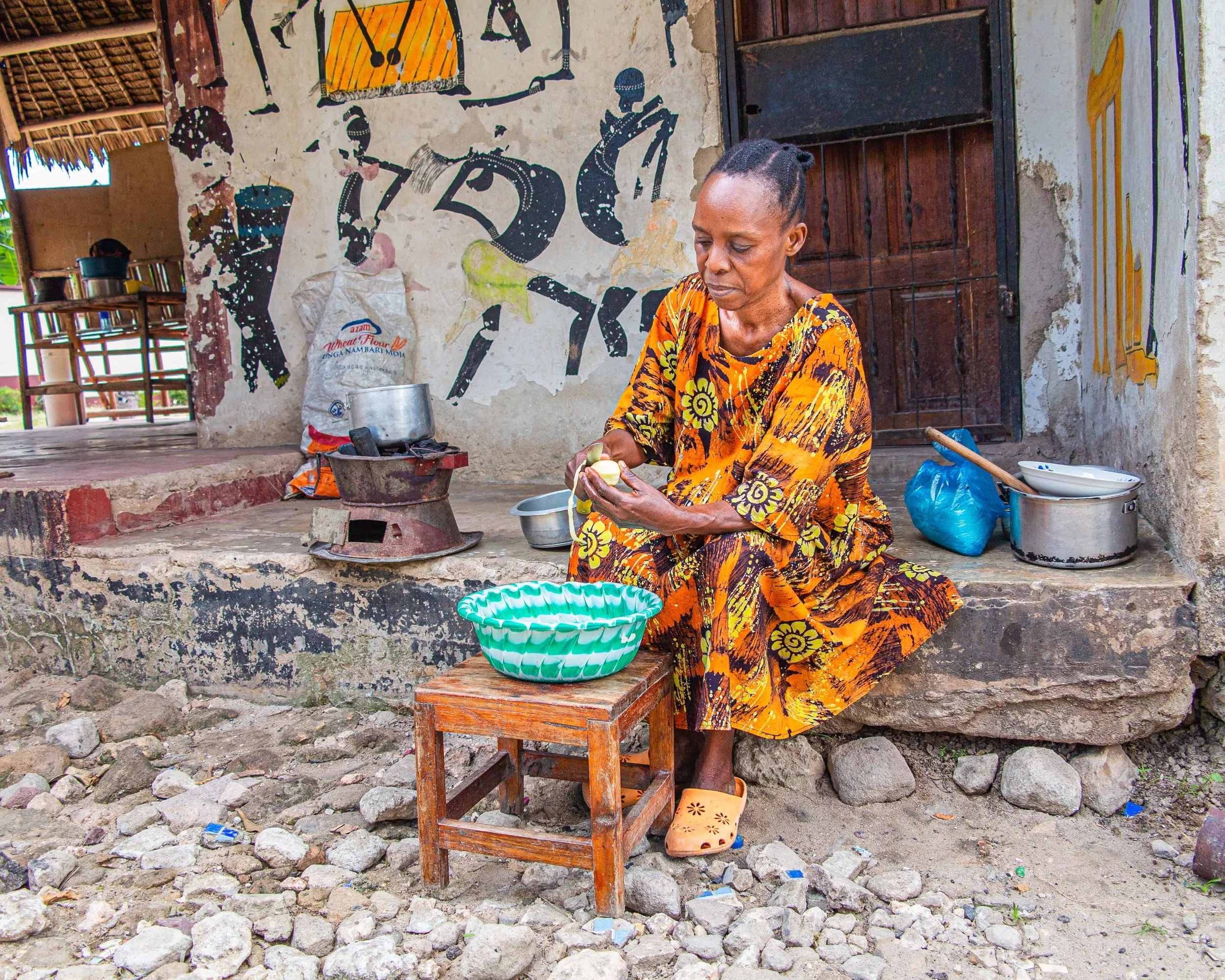
Grandmother peeling potatoes, in Dar es Salaam, Tanzania by Gladness Lyimo
Gender Equality Is Built, Not Delivered
Gender equality is often spoken about at a distance. It appears in global goals and strategy documents, and it sounds clear when written down, but for most, it’s an abstract concept.
But where we work, it looks very different.
It looks like a young woman balancing expectations at home while trying to show up consistently. It looks like entering an industry where she is not always taken seriously, or worse, she is sexually harassed and doesn’t always get paid. It looks like trying to turn a skill into income in a place where opportunities are limited.
These are not side challenges. This is the reality she is working within.
Across photography and other media spaces, women are still underrepresented and often pushed out before they have had the chance to establish themselves.
If we are serious about gender equality, then our programs have to be built with that reality in mind.
We Built This Program With Intention
From the beginning, this program was never just about teaching photography.
It was about asking a simple question. What does she actually need to succeed in male-dominated media spaces?
Not in theory, but in her real life.
We also recognize that we are coming into communities that are not our own. Every time we start a new cohort, we are stepping into a space where trust is not guaranteed. It has to be earned, and then maintained.
So we do not walk in with assumptions. We ask questions. We listen. We pay attention to what is being said and what is not. We look for her discomfort and, instead of ignoring it, keep asking until she feels safe to say her truth. Many organizations want to ignore the hard truths and skim the surface, so they can say they reached their goals. We don’t do that at Cameras For Girls.
Because the truth is, we do not always know what she needs. And when we assume we do, we risk repeating patterns that have not worked before.
So we build with her, not for her, which helps us shape programming that works for her. But what does that look like in practice?
She receives a camera because without it, she cannot begin her journey to expand her skills. Skills she needs to get her foot in the door. She learns technical skills because she needs to be good at her craft. She is trained in ethical storytelling because how stories are told matters. She works with NGOs, so she is gaining real experience, not just practice. She learns business skills because she needs to earn, not just apply. And she is supported through mentorship because entering this space alone is difficult.
This is how we approach gender equality. We design for it.
What the Numbers Actually Look Like
Since 2019, we have been tracking what actually happens to young women as they move through this program. We want to know whether our program leads to jobs, not just talk about it, especially if it isn't true.
The outcomes are not perfect, and we do not try to present them that way.
Out of a cohort of 15, we typically see around 12 young women graduate. Of those 12, about 80% go on to secure paid work. Others take a different route and begin building freelance careers or starting their own businesses.
All of this is happening in places where youth unemployment sits in the low to mid-30% range.
These numbers matter because they show that when the right structure is in place, this work leads to real outcomes.
One of those young women is t, who was part of our second cohort in Tanzania.
She came into the program with interest and ability, but without access to the tools or opportunities to move forward in a meaningful way. Through the training, she developed her technical skills, but, just as importantly, she began to understand how to position herself professionally and how to use storytelling in an ethical, grounded way, using our ethical storytelling framework.
What she did next is what we hope for, but never assume.
She built something of her own.
Today, Gladmess runs a photography and storytelling business, working with NGOs across Dar es Salaam and surrounding cities. She earns income from her work, and she does so in a way that reflects both her skill and perspective.
Her story is not separate from the data. It is what the data represents.
What This Work Actually Does
It would be easy to reduce this work to employment outcomes, because those are the easiest to measure.
But what we see goes further than that.
When a young woman begins earning through this work, it changes how she is positioned at home and in her community. She is seen differently, and she begins to see herself differently as well.
Equally important is that Gladness is now a role model not only to the other girls in our program but also to other girls and women in her community, who can now see a life beyond early marriage or pregnancy as the only way forward.
There is a shift in confidence, in independence, and in what feels possible. And then there is the work itself.
The stories she tells are grounded in her lived experience and the experiences of her surrounding community. When she gets to tell her story in her voice and perspective, it shifts ingrained stereotypes about what Africa looks like.
What we are doing is not just opening a door. We are making sure that when she steps through it, there is something sustainable on the other side.
Why We Stay Honest About It
There is always the option to simplify our stories, making the solution easier to understand and fund.
We could round the numbers up or leave out the parts that are harder to explain. But that would not reflect what the young women in this program are actually navigating.
Some of them need more time. Some face challenges that interrupt their progress. That is not a failure of the program. It is the reality of the environments they work in. The lives they are living.
Many of them get malaria or dysentry, because they have no protection or money to buy essential supplies. Many of them are trying to finish university, our program, and work at the same time, due to financial hardships, and struggle to do it all. They have challenges you and I can never imagine, but they also have resilience and a desire to succeed.
Where We Are Now
We have built a program that works. We see it in the outcomes and in the lives of the women who move through it.
But we are still operating as a founder-led organization, which brings real limitations and, in the long term, is not sustainable.
More young women want to be part of this program. There are more communities where this work is needed. And there is more that we know we could build if we had the organizational and programming funding to do it.
At this stage, the constraint is not whether the model is effective. The question is whether we have the resources to grow it sustainably.
What does that look like?
A fractional marketing person and a fractional fundraiser in Canada, and a country manager and a person in charge of measurement and evaluation in Uganda. We don’t need a large team, but we need one.
We already know this work makes a difference. What we are looking at now is how far it could go.
With the right support, we could expand into new regions, reach more young women, and build stronger systems around them so that their success is not just possible, but sustained over time.
We are not starting from the beginning. We are building on something that has already been tested with successful outcomes.
Be Part of What Comes Next
If you’ve read this far, then you already understand what this work is about and how we are building a successful model.
Organizations like CARE and Plan International started with focused work and grew because people chose to support them.
That is what we are asking for.
Not belief in a perfect model, but support for one that is already working and has the potential to reach much further.
The young women in this program are doing what they need to do to build careers, create income, and shift what is possible in their own communities. What they should not have to do is wait for the support to catch up.
If you are a funder in Africa or Canada, a corporate partner, or someone who believes in building gender equality in a way that is grounded and lasting, then this is where you come in.
We are not asking you to invest in potential. We are asking you to stand behind something that is already in motion and help it grow.
Because what happens next depends on whether this work is resourced to reach the women who are still waiting.