
When Organizations Hire Our Graduates, Everyone Gains
At Cameras For Girls, we talk often about training, mentorship, cameras, and ethical storytelling.
But the ultimate goal has always been paid work.
A camera can help a young woman begin. Training can help her build skills. Mentorship can help her grow in confidence. But none of it matters if it doesn't lead to real opportunities where she can use those skills to earn.
That is the outcome we are working toward.
We want our students and graduates to move into paid positions, whether that is full-time employment, contract work, freelance assignments, or short-term projects that help them build their portfolios and grow their income.
Because training alone does not build a career. Paid work does.
We have been talking about
That is why we are seeking media companies, NGOs, nonprofits, and businesses to Work With Us. It connects organizations, nonprofits, businesses, foundations, and community projects with Cameras For Girls students and graduates ready to support their storytelling needs through photography, videography, and visual content creation.
Recently, we saw exactly why this matters.
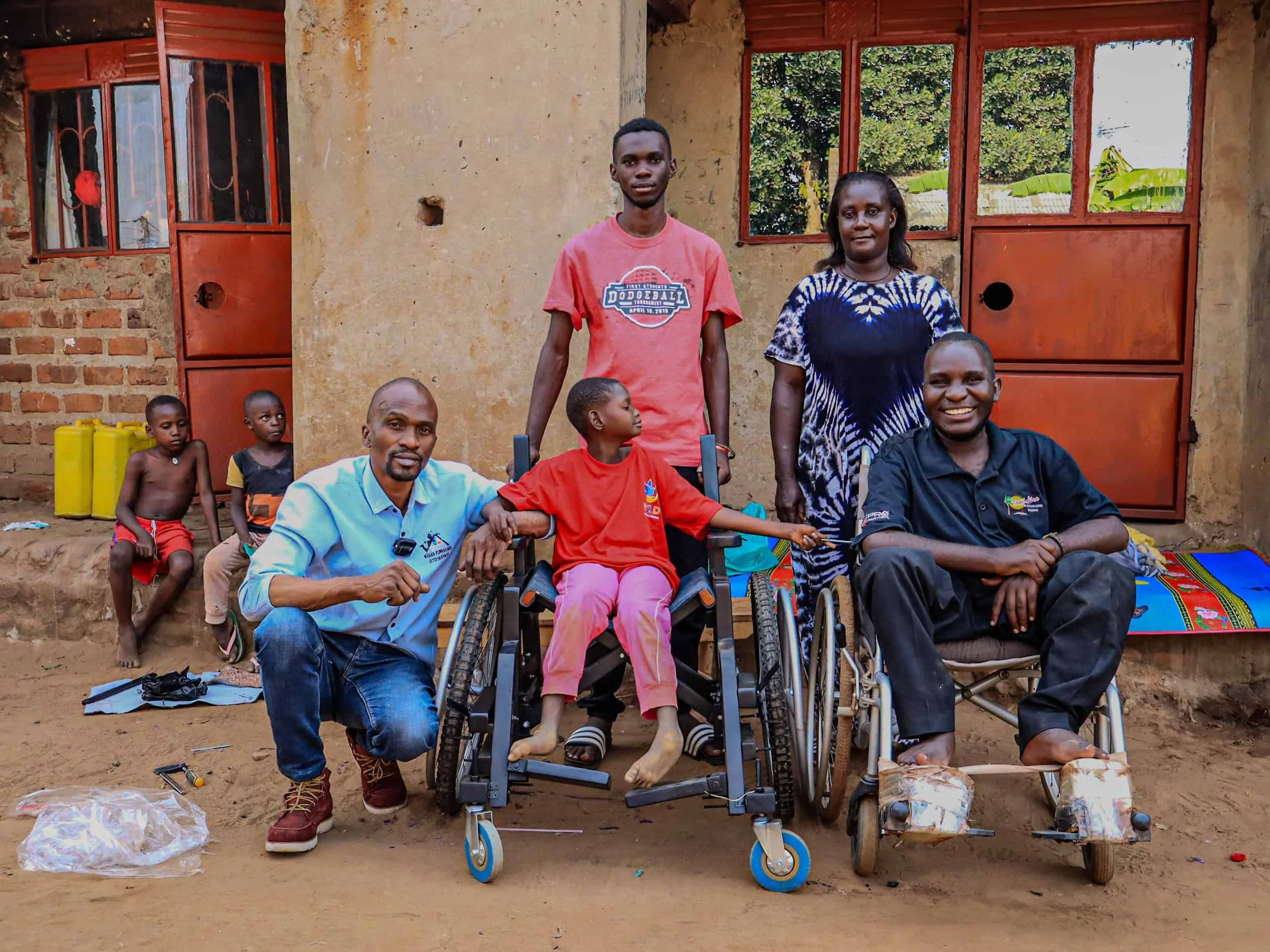
The young girl (center) who received her first wheelchair from Rashid (in wheelchair on the right) and his team at Wheels of Equity, Photo by Kepo Janet Tracy.
A Meaningful Assignment in Mityana District
Rashid Kigenyi, Founder of Wheels of Equity, reached out because his organization was preparing for a wheelchair donation in Mityana District, Uganda. Wheels of Equity makes affordable wooden wheelchairs for people with mobility challenges. For this event, they were donating a wheelchair to a young girl during a birthday celebration.
Rashid wanted the day documented through photography and video.
But what stood out to me most wasn't just that he needed someone to capture the event. It was that he was ready to pay for the work.
Too often, young women entering media are asked to volunteer their time, accept exposure, or prove themselves before they are paid. But exposure does not pay for transport. It does not build financial independence. It does not help a graduate begin to see her skills as income-generating. Only paid work does.
So we connected Rashid with Kepo Janet Tracy, one of our recent Cameras For Girls graduates.
Janet Steps Into the Assignment
Janet took on the one-day job and documented the wheelchair donation through both photos and video.
This was not simply about showing up with a camera and taking pictures. The day carried emotion, meaning, and dignity. A young girl was receiving a wheelchair that would support her mobility, and the story needed to be captured with care.
Janet worked independently, understood the day's purpose, and captured the moments that conveyed the organization's mission. She documented the event in a way that helped Wheels of Equity tell a story of inclusion, mobility, and hope.
Afterward, Rashid shared this testimonial:
“Janet did an amazing job documenting this very special occasion. From the beginning, she was highly professional, creative, and attentive to detail. She understood the important moments to capture and knew exactly how to tell the story through both photographs and video. The final edited pictures and video clips were beautiful and of excellent quality.”
He also shared that what impressed him most was Janet’s professionalism, her ability to work independently, and the way she understood the emotional significance of the activity. That is exactly what we want our students and graduates to be known for.
Not just taking photos, but telling stories with care and dignity.
Why One Paid Assignment Matters
For Janet, this assignment was more than a one-day job. It was a chance to use her training in a real setting. It gave her new photos and videos for her portfolio. It gave her experience working with a client. It gave her a testimonial she can use when applying for the next opportunity.
That is how the ball starts rolling.
One assignment can lead to another.
One client can lead to a referral.
One testimonial can help answer the question, “Have you done this before?”
And one paid opportunity can help a young woman begin turning her skills into income.
This is why we say training is only the beginning.
The real measure of success is whether our students and graduates can turn that training into paid work, professional experience, client relationships, stronger portfolios, and sustainable income from their skills.
Why Organizations Gain Too
When an organization hires a Cameras For Girls graduate, they also benefit. They gain access to someone who understands photography, videography, ethical storytelling, and the importance of documenting community work with respect.
They receive visual content they can use for reports, social media, donor updates, campaign materials, websites, and storytelling. They work with a young woman who understands the local context and can approach people with care, while they create paid work pathways for young African women in media.
That is what makes this model powerful. The organization gets the story documented. The graduate gets paid experience. The community story is captured with dignity.
Everyone gains.
A Thank You to Wheels of Equity
We are grateful to Rashid and Wheels of Equity for trusting Janet to document such an important day. We are grateful that they saw the value in hiring a trained storyteller. We are also grateful that Janet had the opportunity to step into a real assignment, work with a client, document a meaningful story, and show what she can do. This is the kind of partnership we want to see more of.
Organizations need strong stories that help people understand their work, connect with the communities they support, and see the impact behind the numbers.
Our graduates need paid opportunities that let them strengthen their portfolios, build confidence, gain references, expand their professional networks, and earn income from the skills they have worked hard to develop.
When those two needs meet, the result is more than a single photography assignment. It is also how training begins to translate into economic opportunity.
For Cameras For Girls, this has always been the larger goal. We do not want our graduates to simply complete a photography program and walk away with new skills. We want those skills to become a pathway into paid work and, ultimately, a sustainable career in media.
Partnerships like this help make that possible.
Work With Us
If your organization, nonprofit, business, foundation, school, or community project is based in Uganda, Tanzania, or working in the regions where our graduates live, we would love to connect you with a Cameras For Girls storyteller.
You can hire our students and graduates for photography, videography, event coverage, ethical storytelling, field documentation, campaign content, portraits, and visual storytelling projects.
The next story could be yours. The next paid opportunity could be hers.