
Why Funding Women in Media Is an Investment in Economic Opportunity
When people think about funding women in media, they often think about the visible parts first.
A camera. A workshop. A photograph. A young woman learning how to tell a story.
Those things are important, because they are part of the work. But they are not the full picture.
At Cameras For Girls, we see media training as more than a creative opportunity. We see it as a pathway to income, employment, confidence, and long-term economic opportunity for young African women who already have the talent, education, and drive to build careers in journalism, photography, communications, and storytelling.
What many of them lack is not ambition. It is access.
Access to equipment. Access to practical training. Access to mentors. Access to business skills. Access to the first paid assignment that helps turn learning into earning.
That is why funding women in media matters.
Because when a young woman gains the tools and support to work in media, she is not only learning how to use a camera. She is building skills she can use to earn, contribute, lead, and shape the stories being told in her own community.
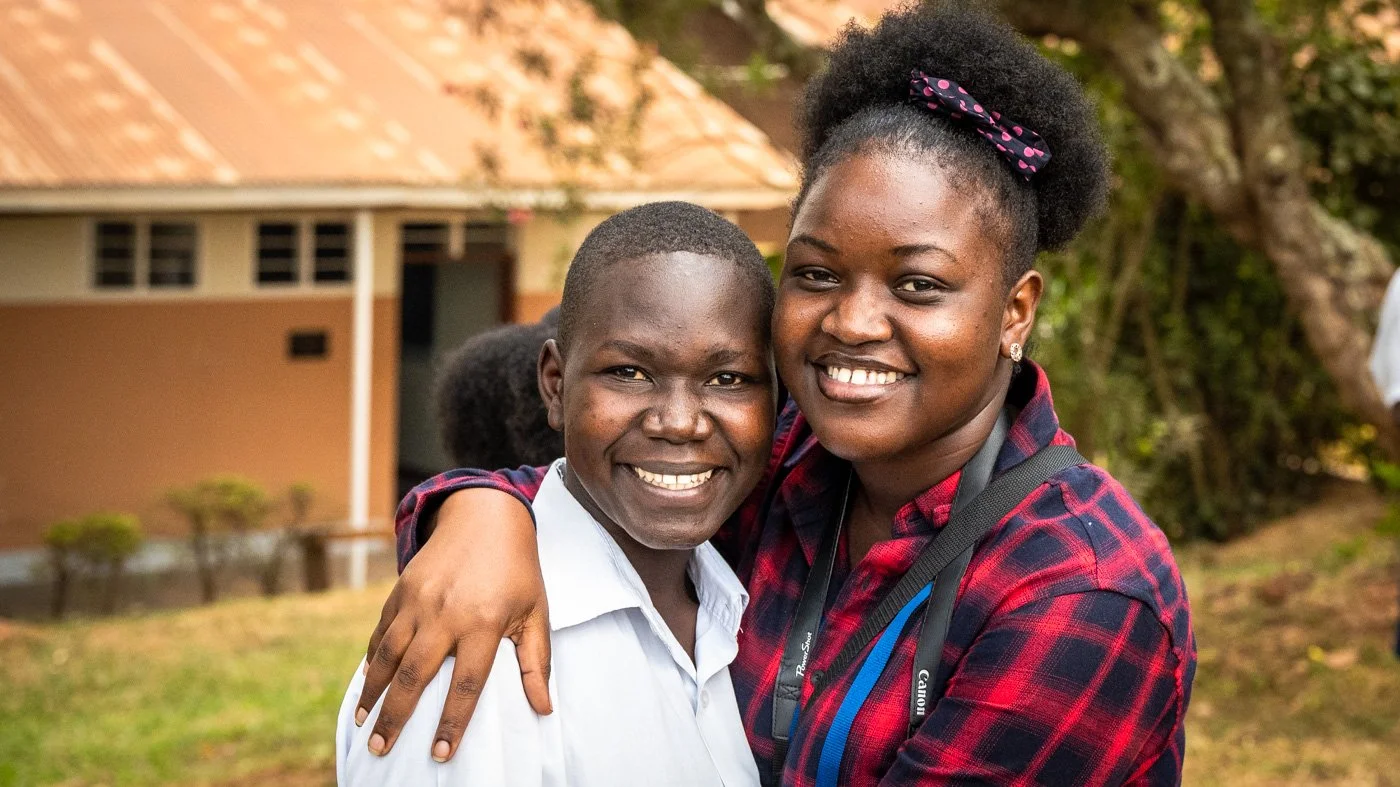
Melanie Nabukwasi, one of our Cameras For Girls trainers with a student she mentors. Photo by Amina Mohamed
The Barrier Is Often Practical
Many of the young women we work with have already studied journalism, communications, photography, or media. They are not starting from zero. They have spent years learning theory, writing papers, attending lectures, and imagining what a future in media could look like.
Then they graduate and face a very practical barrier.
They are told they need a camera. They are told they need experience. They are told they need a portfolio. They are told they must prove they can do the work before they are given the chance to do it.
That is where many young women get stuck.
Not because they are not capable, but because the bridge between education and employment is missing.
A camera can be expensive. Professional training can be out of reach. Mentorship is not always available. Paid assignments often go to those who already have networks, equipment, and experience.
For young women trying to enter male-dominated media spaces, those barriers can be even harder to move through.
This is the clear gap that funding helps close: practical barriers. It helps a student receive a camera to keep. It helps her learn how to use it well. It helps her build a portfolio, understand ethical storytelling, gain business skills, and prepare herself for paid work.
That is the beginning of an economic pathway we can build on, student by student and country by country.
Media Skills Are Income-Generating Skills
Photography and storytelling are often treated as creative skills, and they are. But they are also income-generating skills.
A young woman trained in photography, ethical storytelling, communications, editing, and visual content creation can use those skills in many different ways.
She can work with a media house. She can support a nonprofit with field stories. She can photograph events. She can create content for a small business. She can support communications teams. She can document community work. She can build a freelance portfolio.
She can use her camera to open doors into journalism, advocacy, marketing, social media, brand storytelling, and documentary work.
This is why media training must be taken seriously as economic development.
When a young woman can earn from her skills, the impact goes beyond one assignment.
It affects how she sees herself. It affects what choices she has. It affects how she contributes to her household.
It affects whether she can keep building her career instead of stepping away because the industry was never designed to support her.
Paid work changes what becomes possible.
What We Lose When Women Are Missing From Media
When women are missing from media, some stories are never told fully, and some are never told at all.
A rural woman living with illness, poverty, abuse, or the lasting harm of practices such as FGM may not feel safe, seen, or understood enough to share her truth with a male journalist. Even when she does speak, the deeper context of her lived experience may be missed. Her pain becomes a brief quote. Her reality becomes a statistic. Her story never reaches the people who need to hear it.
When these stories remain untold, it becomes easier for the world to believe these issues don't exist, don't matter, or are too far away to care about. That is what we lose when women are not behind the camera, holding the microphone, asking the questions, and shaping the story.
Economic Opportunity Also Means Being Paid Fairly
It is not enough for young women to be invited into media spaces if they are not paid fairly for their work.
Too often, creative work is undervalued. Young women may be asked to volunteer, accept exposure instead of payment, or take on assignments without clear rates or expectations. This can keep them visible but still economically vulnerable.
At Cameras For Girls, we want our students to understand that their work has value. Their time has value. Their skill has value. Their perspective has value.
When they are trained to use a camera, tell stories ethically, and work professionally, they are not doing a favour for the person or organization hiring them. They are providing a service.
It helps a young woman move from hoping for an opportunity to preparing for paid work with confidence and clarity.
Women in Media Strengthen the Stories Being Told
Funding women in media is also an investment in better storytelling. When more African women are behind the camera, the story changes. The questions change. The perspective changes. The relationship with the person being photographed changes.
Stories are not only told from the outside looking in. Women tell them, drawing on their understanding of the communities, cultures, languages, and realities around them. That does not mean every story is easy or positive. It means the story has a better chance of being told with context, dignity, and care.
This matters for journalism. It matters for nonprofit communications. It matters for businesses. It matters for communities. And it matters for the future of media across Africa.
When women are excluded from media work, everyone loses part of the story.
Donor Support Creates More Than a Training Moment
For donors and funders, the question shouldn't be only, “How many students attended the training?”
The deeper question is, “What became possible after the training?”
Did the student build confidence? Did she keep using her camera? Did she gain paid work? Did she build a portfolio? Did she support a client, newsroom, nonprofit, or business? Did she begin to see herself as a media professional?
This is where funding has long-term value.
A donation to Cameras For Girls does not stop at the workshop. It supports the full pathway from learning to practice, from practice to confidence, and from confidence to paid work.
That is why this work matters to funders who care about gender equity, education, decent work, economic opportunity, ethical storytelling, and locally rooted leadership.
It is practical, measurable, and deeply human.
Support Economic Opportunity for Women in Media
Young African women today are ready to build careers in journalism, photography, communications, and storytelling. They have the drive. They have the education. They have the perspective.
What they still need is access to the tools, training, mentorship, and paid pathways that can help them move forward.
When you support Cameras For Girls, you help provide that access. You help a student receive a camera to keep. You help her learn photography and ethical storytelling. You help her gain business skills and mentorship. You help her prepare for paid work in media. And you help build a future where more African women are not only included in media, but paid to shape it.
Support Cameras For Girls today and invest in economic opportunity for women in media.