
Why Mental Health Is Central to Our Photography Workshops
When we first launched Cameras For Girls, our mission was clear: train young African women in photography and ethical storytelling to help them build careers in male-dominated media.
But it did not take long to realize that before they could step confidently behind the camera or into a newsroom, many had to overcome something far more pervasive than technical skills gaps; deeply rooted mental barriers formed by years of systemic inequality, gender based violence, and cultural conditioning.
As we prepare for our 3rd cohort in Tanzania this coming January, I cannot help but remember the discussions that emerged in our very first cohort.
During a session on self-advocacy, one young woman quietly said, "I cannot advocate for myself."
I paused and asked, "Who told you that?"
Her silence spoke volumes.
That moment was not just heartbreaking. It was revealing. It showed us the powerful hold that cultural norms and generational beliefs have in silencing women. It is this conditioning that keeps so many young women in unsafe relationships, outside of leadership roles, or left behind in careers they are more than capable of thriving in.
That one moment changed the way we teach forever.
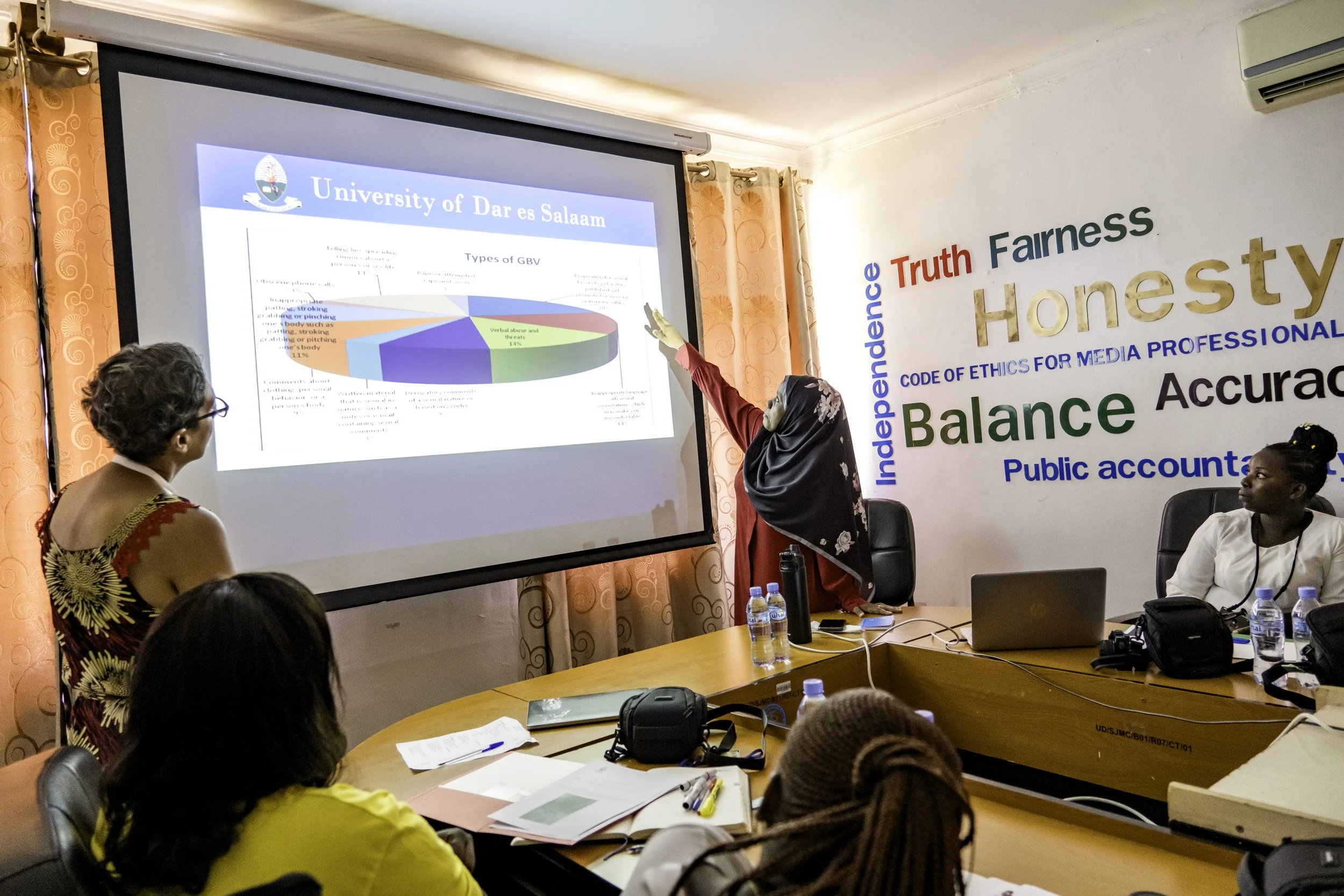
Zuhura Selemani of the University of Dar es Salaam, during a mental health session
The Role of Mental Health in Self -INpowerment
Mental health training and advocacy has become a permanent part of our four-day in-person workshops in both Uganda and Tanzania. But we don’t stop there. Through our vast network, we continue to train them on advocacy tools, and even have a private WhatsApp support group, led by two amazing women from Australia, Trish and Azadi. As former victims of abuse, they have found a way to give back by healing others.
We realized that teaching photography without addressing the emotional weight, the trauma, and the silencing these women carry is like giving someone a camera with no power source. They need more than tools -they need space to reclaim or find who they are.
We do not use the term "empowerment" because that implies something is being given to these women. Instead, we talk about INpowerment because we believe everything they need is already within them. Our job is to help them access it.
And mental health support is essential to that process.
A New Collaboration with TAHMEF in Tanzania
As we prepare to lead our third cohort in Dar es Salaam, in partnership with the University of Dar es Salaam, from January 23 to 26, 2026, we are expanding our mental health programming in powerful ways.
We are honoured to collaborate with TAHMEF, the Tanzania Health and Mental Empowerment Foundation. This local organization is working to change how mental health is understood and addressed in Tanzania.
When I reached out to Dr. Juliana Busasi, TAHMEF's Executive Director, to explore a partnership, she and her team responded with warmth, commitment, and a shared vision.
TAHMEF will lead a dedicated session during our upcoming workshop and also support these women through quarterly seminars. Their focus will be on emotional wellness, healing from trauma, and building the confidence to speak up for oneself, even when culture, family, or fear says not to.
Yes, we teach photography. We teach ethical storytelling. We offer business training. But all of that depends on one critical thing: the belief that you and story matters.
Mental health is not a side topic. It is the foundation. Without it, the camera remains just a tool. When paired with inner healing and self-belief, it becomes a voice.
The Story Continues
As we return to Tanzania in 2026, we carry with us more than cameras and course material. We carry the intention to continue asking honest and necessary questions:
Who told you that you are not worthy?
Who gains from your silence?
What story do you need to tell the world?
And most importantly—how can we support you in telling it?
Because when a woman tells her own story from a place of clarity and self-belief, it does not just change her life. It changes everything.The Role of Mental Health in Self -INpowerment
Mental health training and advocacy has become a permanent part of our four-day in-person workshops in both Uganda and Tanzania. But we don’t stop there. Through our vast network, we continue to train them on advocacy tools, and even have a private WhatsApp support group, led by two amazing women from Australia, Trish and Azadi. As former victims of abuse, they have found a way to give back by healing others.
We realized that teaching photography without addressing the emotional weight, the trauma, and the silencing these women carry is like giving someone a camera with no power source. They need more than tools -they need space to reclaim or find who they are.
We do not use the term "empowerment" because that implies something is being given to these women. Instead, we talk about INpowerment because we believe everything they need is already within them. Our job is to help them access it.
And mental health support is essential to that process.