
Drone Photography Through a Woman’s Eye View
By Elfrida Rutta
“I once met a group of men operating a drone, and they told me that drone operation is more like a video game and only boys are interested in these games.”
“It is technical equipment, and people think it will be tricky when a woman handles it compared to a man.”
“People think drones are sophisticated, and they believe women don’t like too much technical work.”
These are some of the comments from the people I interviewed for my dissertation titled “The perception of women photographers in pursuing drone photography in Tanzania.” Through my time with Cameras For Girls, I learned a lot about photography, editing, and ethical storytelling. I have been inspired to create work that sheds light on human aspects, but also assesses the challenges that still exist in the photography field. After learning a lot about women in creative spaces, I wanted to do more research in this area.
As we live in a technology-driven world, drone operations and photography were definitely areas of interest for me. While I have seen drone use in the media grow, there has been a significant dominance of men in its operation, which led to my dissertation topic. Upon studying the existing literature and conducting interviews, the first step in understanding this problem was to uncover the myth that “women are not interested in technical operations such as drones.”
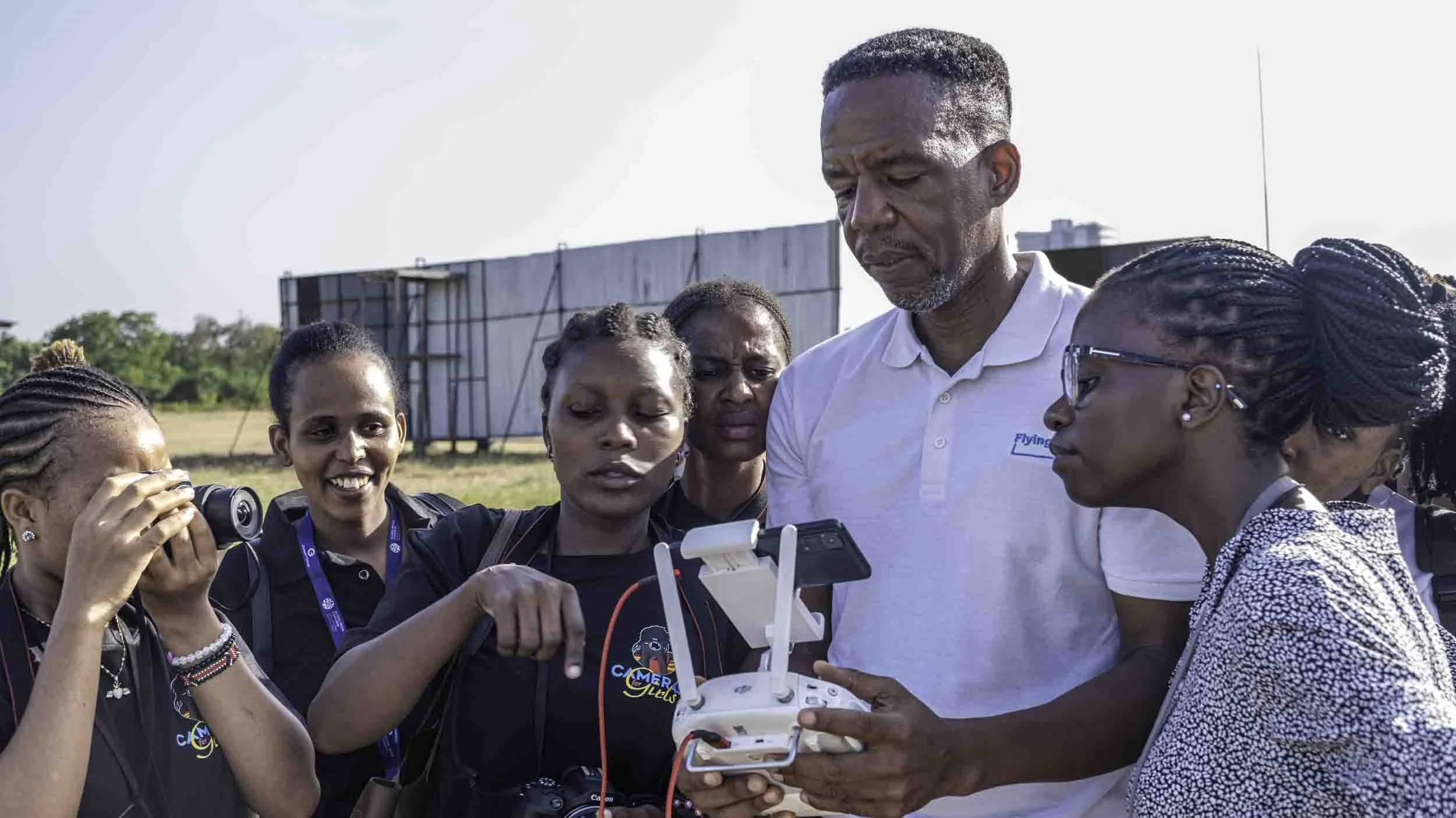
Leka Tingitana, of Tanzania Flying Labs, demonstrating how to fly a drone for Cohort 3, in Dar es Salaam, Tanzania, January 25, 2026.
The Truth
The research collected views from photographers, trainers, and other professionals, both women and men. It was conducted over about 4 weeks, and the findings showed perceptions of women photographers regarding drone photography, the challenges they face as women, and opportunities and strategies to support women entering drone photography.
The results highlighted that it is not true that women are not interested in technical operations; rather, they are simply discouraged by societal or cultural views. One of the respondents shared the statement, “Before a woman can even try to learn, there are voices already telling her drones will be complicated for her; she'd better let the men do it. This discourages our dreams.” This suggests that women sometimes face challenges in wanting to learn due to the pressure from negative voices around them.
Another major challenge raised by the respondents was the cost of drones, and women’s safety, being a minority group in the learning environments. Women fail to learn because of the high costs of drones, whether buying or renting. The dominance of men in this field also raises concerns about women’s safety in learning spaces. Some of the strategies and opportunities suggested for supporting women in drone photography included the power of women's representation in the drone field, alternative learning methods, access to trainers, cost-sharing for equipment acquisition, and safe, gender-inclusive training programs.
The Way Forward
While challenges are always there, it is what we choose to do next that determines our path. For their 3rd cohort program, Cameras For Girls will be partnering with Tanzania Flying Labs to offer drone training. This is a great opportunity for women interested in drone photography. Women are very much needed in this field, not just to fill the gender gap, but also to enrich the field through a woman’s perspective, style, and visual voice. I believe it will be a significant step towards building a future of more talented, skilled, and very hardworking women who can belong in the field of drone photography and so much more.
Cameras For Girls opened a door for me to get into photography, thanks to very talented, skilled, and hardworking trainers and my other colleagues. Since then, I have been exploring different themes in photography, like documentary and sports, and, more recently, short filmmaking with the same camera I got from the program. I am very excited to take part in the upcoming drone training, as it will expand my knowledge and skills in photography, introduce me to more creative storytelling approaches, and add value to this very creative and competitive field. I hope to use my gifts and skills for good and be an inspiration for other women in Tanzania and beyond.